Sowell Bay pier
Remarkably Bright CreaturesSowell Bay pier is both a physical landmark and a meeting place for the novel’s crossings between ordinary life, danger, and private reflection. Cameron visits it after gaining a measure of trust at work; Avery recalls talking a woman away from its edge; and Tova returns to its familiar bench at a moment when her family and home seem to be disappearing. The pier’s open water offers a view outward, but its height, rocks, and railings make that openness precarious.
Setting and Physical Character
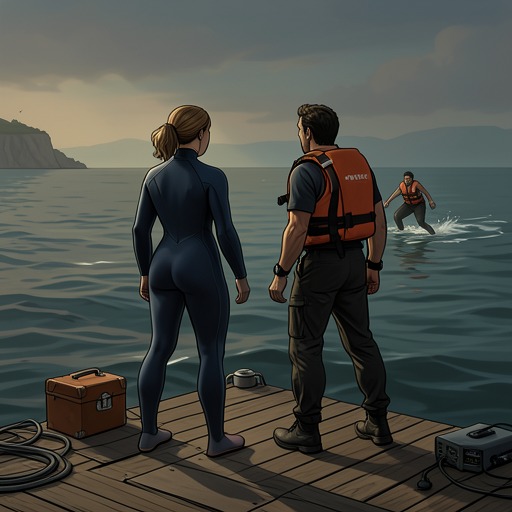
The pier extends into the water beside Sowell Bay’s aquarium, where Tova has a usual bench. It is a long wooden structure with a slanted railing, barnacle-crusted pilings, and water that changes character with light and depth. At high noon, sunlight throws silver streaks across the surface; beneath the pier’s shadow, the water appears inky, and kelp clings just below the surface. Paddleboards drift close enough to knock gently together as small swells carry them toward the dock.
The structure is not merely picturesque. Avery warns Cameron that the drop from the railing can be about thirty feet, depending on the tide, with sharp rocks and old pilings below. Teenagers sometimes treat the slanted rail as a tightrope, an act that makes the pier’s casual public life look suddenly dangerous. Its waterfront beauty and physical hazards occupy the same frame: the reflected light and the view do not soften the consequences of a fall.
Work, Encounters, and Possible Futures
After Cameron receives a key card from his employer, he waits for Ethan Mack by wandering down the pier. The key represents unfamiliar trust: Cameron has never before had a boss who entrusted him with one. He photographs it against the water and sends the image to Jeanne, making the pier the backdrop to a small but meaningful record of his changing circumstances. As he sends it, a call comes in from the number he has been trying repeatedly to reach; the scene leaves its outcome unresolved.
The pier also becomes part of Cameron’s imagined future. While living in his camper in Ethan’s driveway, he looks out at night over Puget Sound waters and wonders what it would be like to wake beside the shore with the water filling his windshield. For now, he does not park in a public lot overnight: Ethan says the town’s patrolman, Mike, would relish towing a camper. Cameron’s wish for a home with a water view remains conditional on finding Simon Brinks. The pier thus frames an aspiration, not an arrival; its open horizon contrasts with Cameron’s temporary living arrangements and uncertain search.
The waterfront carries older local history as well. Ethan tells Cameron that Tova Sullivan’s son, Erik Sullivan, worked the ferry dock in the late 1980s, where he was remembered as a brilliant student and athlete. The account establishes the ferry dock as part of the town’s working waterfront and Erik’s past, but does not establish that the ferry dock and the pier are the same structure. That distinction keeps the pier’s present-day scenes connected to Sowell Bay’s maritime life without collapsing separate locations into one.
Danger and Rescue
While paddleboarding with Cameron, Avery watches teenagers balance along the pier railing and explains the risk beneath them. The conversation turns to her own experience: she once came ashore, approached a woman at the pier, and talked her down from jumping. Avery says that listening was what helped. Her account recasts the site from a scenic destination into a place where someone’s presence and attention can interrupt a crisis.
Later, at the pier, Avery tells Tova about the same rescue in more specific terms. A few years earlier, she had been paddling very early in the morning when she saw a woman sitting on the railing, talking to herself. Avery describes the woman as looking rough and possibly under the influence; she went over and talked with her. The woman’s identity is not supplied in this account, and the narration does not expand on what followed beyond Avery’s intervention. What matters for the pier’s role is the repeated association between its exposed edge and a choice that can still be changed: Avery’s practical response was to approach and listen.
Memory and the Closing Scene
The pier’s recurring use links different kinds of waiting. Cameron waits there after receiving the key card and as he continues trying to reach someone. Avery’s story recalls an early-morning encounter there. Tova, meanwhile, sits on her usual bench beside the aquarium, looking at the water under a silver moon. The familiar place holds still while the circumstances around her have shifted: Marcellus is gone, Cameron has gone, and her house is about to be sold.
At that late moment, Tova decides she will not move to Charter Village. The pier does not resolve her losses, and its water does not offer an explanation for the past. Instead, it gives the closing reflection a specific location from which to register both absence and persistence. Tova’s home is about to be gone, but she insists that she herself will not be gone. Against the pier’s repeated images of dangerous edges and open water, that distinction makes the setting a place not only of risk and remembrance, but of continued presence.